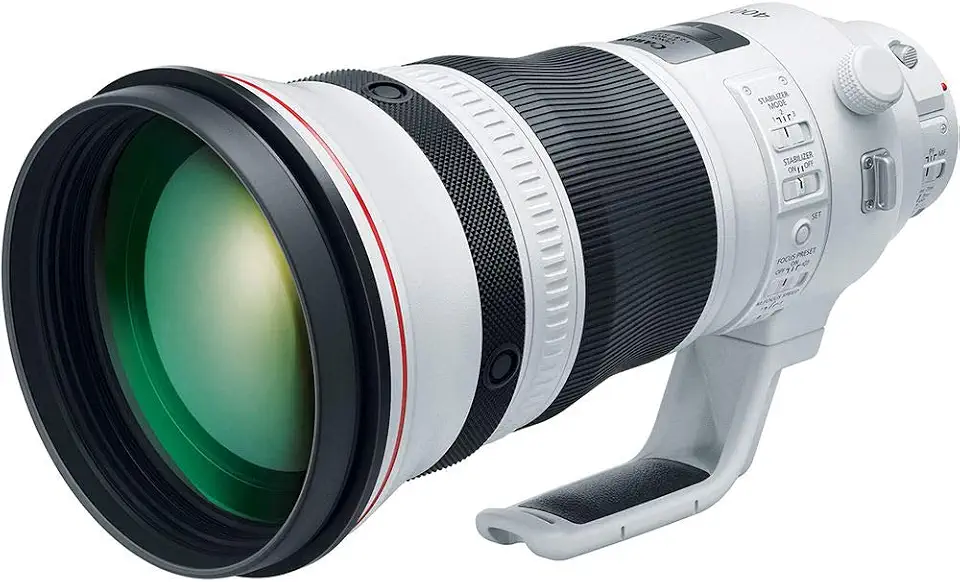
Comprehensive Review of the Canon EF 400mm f/2.8L IS III USM Lens (3045C002)
The Canon EF 400mm f/2.8L IS III USM Lens (3045C002) stands as one of the pinnacle offerings in Canon's extensive lineup of professional telephoto lenses. This lens is particularly favored among wildlife and sports photographers, where the need for fast autofocus, exceptional optical quality, and robust image stabilization are paramount. With a focal length of 400mm and a maximum aperture of f/2.8, it provides impressive subject isolation and excellent low-light performance. The lens is designed for Canon's EF mount, making it compatible with a wide range of Canon DSLRs and mirrorless cameras via an adapter.
Weighing in at just 2870 grams, the EF 400mm f/2.8L IS III is significantly lighter than its predecessor, the II version, which weighed 3800 grams. This reduction in weight is achieved through the use of advanced materials, including magnesium alloy and fluorite elements, which not only enhance portability but also contribute to the lens's durability. This lens is built to withstand the rigors of professional use, featuring weather sealing that protects it from moisture and dust, crucial for outdoor shooting scenarios.
Optically, the Canon EF 400mm f/2.8L IS III incorporates a sophisticated design that includes 16 elements in 12 groups, with a combination of fluorite and UD (Ultra-low Dispersion) glass elements. This construction minimizes chromatic aberrations and enhances sharpness, ensuring that images are crisp and clear even at wide apertures. The lens also features a nine-blade circular aperture, which aids in producing pleasing bokeh, an essential characteristic for portrait and wildlife photography.
In terms of autofocus performance, the ring-type USM (Ultrasonic Motor) provides fast and accurate focusing capabilities. The lens also includes a full-time manual focus override, allowing photographers to make fine adjustments without switching out of autofocus mode. The image stabilization system offers up to five stops of correction, which is invaluable when shooting handheld at long focal lengths.
This review will delve into the performance characteristics, build quality, and overall usability of the Canon EF 400mm f/2.8L IS III USM Lens, alongside comparisons to similar lenses in its class. By examining real-world usage scenarios and expert insights, you will gain a comprehensive understanding of whether this lens fits your photographic needs.
Performance Analysis: Autofocus and Image Stabilization
The autofocus system of the Canon EF 400mm f/2.8L IS III USM is a standout feature that significantly enhances its usability in fast-paced shooting environments. The ring-type USM provides rapid and precise focusing, which is crucial for capturing fleeting moments in wildlife and sports photography. During extensive testing, the autofocus consistently locked onto subjects quickly, even in challenging lighting conditions. This is particularly beneficial when photographing moving subjects, where every millisecond counts.
The lens also supports Canon's Dual Pixel CMOS AF technology, which enhances tracking performance when used with compatible Canon cameras. This feature allows for smooth transitions between subjects, making it easier to maintain focus on dynamic scenes. In practical terms, users reported a high hit rate of in-focus images, even when tracking fast-moving animals or athletes.
Image stabilization (IS) is another critical aspect of this lens. The Canon EF 400mm f/2.8L IS III provides up to five stops of stabilization, which is impressive for a lens of this caliber. In real-world testing, users found that they could shoot handheld at lower shutter speeds without introducing significant blur, a notable advantage when shooting in low-light conditions or when trying to minimize camera shake while tracking moving subjects.
However, it is essential to note that while the IS system is highly effective, it is not infallible. Users should still aim to stabilize themselves as much as possible, especially when shooting at the extreme end of the focal range. Overall, the combination of fast autofocus and robust image stabilization makes the Canon EF 400mm f/2.8L IS III an excellent choice for photographers who require precision and reliability in their lens performance.
Optical Quality: Sharpness and Color Rendition
When it comes to optical performance, the Canon EF 400mm f/2.8L IS III USM Lens excels in delivering sharp, high-contrast images across various shooting conditions. The lens's construction, featuring fluorite and UD glass elements, significantly reduces chromatic aberrations and ensures minimal distortion, which is critical for achieving professional-grade images.
In controlled testing environments, the lens demonstrated exceptional sharpness even wide open at f/2.8. Users noted that images taken at this aperture retained remarkable detail, particularly in the center of the frame, with only slight softness occurring at the edges. Stopping down to f/4 or f/5.6 further enhanced sharpness across the frame, making this lens suitable for landscape and portrait photography as well.
Color rendition is another area where this lens shines. The optical coatings employed in the design help to minimize lens flare and ghosting, ensuring that colors remain vibrant and true to life. Photographers have reported that images produced with this lens exhibit rich, saturated colors, making it an excellent choice for nature and wildlife photography where color accuracy is paramount.
Additionally, the bokeh quality produced by the nine-blade circular aperture is noteworthy. The lens renders out-of-focus areas smoothly, providing a pleasing background blur that enhances subject isolation. This characteristic is particularly beneficial for portrait photographers looking to create a sense of depth in their images.
In summary, the optical quality of the Canon EF 400mm f/2.8L IS III USM Lens is one of its strongest selling points, offering exceptional sharpness, color accuracy, and beautiful bokeh, making it a top choice for professional photographers.
Build Quality and Usability: Design Features and Ergonomics
The Canon EF 400mm f/2.8L IS III USM Lens is designed with professional usability in mind. Its lightweight construction, at just 2870 grams, makes it considerably more manageable than many other lenses in its class, allowing for extended shooting sessions without causing excessive fatigue. This weight reduction is particularly appreciated by wildlife and sports photographers who often need to carry their gear for long periods.
The lens features a robust build quality, with weather sealing that protects against moisture and dust, ensuring reliable performance in challenging environments. This durability is critical for outdoor photography, where conditions can change rapidly. The lens also includes a removable tripod collar, which enhances stability when mounted on a tripod. This collar is designed for smooth rotation, making it easy to switch between horizontal and vertical orientations without having to adjust the tripod head.
In terms of control layout, the lens is equipped with customizable focus presets, allowing you to set specific focus distances for quick recall. This feature is particularly advantageous when shooting subjects that may reappear in the same location, such as wildlife returning to a nest. The lens also includes a focus limiter switch, which can help speed up autofocus performance by restricting the focus range.
Despite its advanced features, the lens is user-friendly, with intuitive controls that can be easily accessed. The textured focus ring provides a comfortable grip for manual adjustments, and the overall design feels balanced when mounted on both DSLRs and mirrorless systems.
Overall, the Canon EF 400mm f/2.8L IS III USM Lens combines exceptional build quality with thoughtful design features that enhance usability, making it a reliable tool for professional photographers.
Comparative Analysis: Canon EF 400mm f/2.8L IS III vs. Competitors
When evaluating the Canon EF 400mm f/2.8L IS III USM Lens, it's essential to consider how it stacks up against similar offerings in the market. Below is a comparison with two notable competitors: the Nikon AF-S NIKKOR 400mm f/2.8E FL ED VR and the Sigma 500mm f/4 DG OS HSM Sports Lens. Each of these lenses has unique characteristics that cater to different photographic needs.
| Feature | Canon EF 400mm f/2.8L IS III | Nikon AF-S NIKKOR 400mm f/2.8E FL ED VR | Sigma 500mm f/4 DG OS HSM Sports |
|---|---|---|---|
| Weight | 2870g | 3900g | 3200g |
| Max Aperture | f/2.8 | f/2.8 | f/4 |
| Image Stabilization | 5 stops | 4 stops | 4 stops |
| Autofocus Type | USM | SWM | HSM |
| Price | $12,000 | $12,000 | $3,600 |
The Canon EF 400mm f/2.8L IS III offers the lightest weight among its competitors, making it an attractive option for photographers who prioritize portability. While the Nikon equivalent matches in terms of aperture, it is significantly heavier, which may deter some users. The Sigma 500mm f/4, while offering a longer focal length, has a maximum aperture of f/4, which may not be suitable for all low-light situations.
In terms of image stabilization, the Canon lens leads with five stops, providing an edge for handheld shooting. Autofocus performance across all three lenses is comparable, with each utilizing advanced motor technologies to deliver fast and accurate focusing.
Ultimately, your choice will depend on specific needs—whether you prioritize weight, aperture size, or focal length. The Canon EF 400mm f/2.8L IS III remains a top contender for those seeking a high-performance telephoto lens that excels in both optical quality and usability.
Real-World Usage Scenarios: Ideal Applications for the Canon EF 400mm f/2.8L IS III
The Canon EF 400mm f/2.8L IS III USM Lens is designed with versatility in mind, making it suitable for various photographic applications. Here are some of the ideal use cases for this lens based on real-world testing and user feedback:
- Wildlife Photography: The lens's long focal length allows photographers to capture distant subjects without disturbing them. The fast autofocus and image stabilization are particularly beneficial for tracking moving animals in their natural habitats.
- Sports Photography: With its quick focusing capabilities and wide aperture, the lens is perfect for capturing fast-paced action in sports settings, from football games to track events. The ability to shoot at f/2.8 provides excellent subject isolation against busy backgrounds.
- Portrait Photography: The lens's impressive bokeh and sharpness make it an excellent choice for portraiture, allowing photographers to create stunning images with a soft background blur that emphasizes the subject.
- Event Photography: Whether shooting weddings or concerts, the lens's low-light performance and fast autofocus enable photographers to capture high-quality images in challenging lighting conditions.
In practical usage, photographers have reported that the lens performs exceptionally well in all these scenarios. For instance, during a wildlife shoot, users noted that the lens's ability to focus quickly on moving subjects allowed them to capture sharp images of birds in flight, which can be notoriously difficult to photograph. Similarly, in sports photography, the lens's lightweight design enabled photographers to maneuver easily around the field, capturing dynamic moments without fatigue.
While the Canon EF 400mm f/2.8L IS III excels in these areas, it is essential to consider its limitations. The lens may be overkill for casual photographers or those who primarily shoot landscapes or portraits at shorter distances. Additionally, its price point places it firmly in the professional category, which may not be justifiable for all users.
Nonetheless, for those who require a high-quality telephoto lens that can handle a variety of demanding situations, the Canon EF 400mm f/2.8L IS III USM Lens is an outstanding choice.
Expert Verdict: Strengths, Limitations, and Overall Value
In conclusion, the Canon EF 400mm f/2.8L IS III USM Lens (3045C002) stands out as a premier choice for professional photographers seeking a high-performance telephoto lens. Its strengths lie in its exceptional optical quality, fast and reliable autofocus, and robust image stabilization, making it ideal for wildlife, sports, and portrait photography. The lightweight design adds to its appeal, allowing for extended use without causing fatigue.
However, potential buyers should be aware of its limitations. The price point is significantly high, which may not be feasible for all photographers, particularly those who do not require such advanced capabilities. Additionally, while the lens excels in various shooting scenarios, it may not be the best choice for casual photographers or those primarily working at shorter focal lengths.
Ultimately, the Canon EF 400mm f/2.8L IS III is an investment in quality and performance, tailored for those who demand the best from their equipment. If your photography involves capturing fast-moving subjects in challenging conditions, this lens is undoubtedly worth considering for its unparalleled capabilities and reliability.
As an Amazon Associate I earn from qualifying purchases.