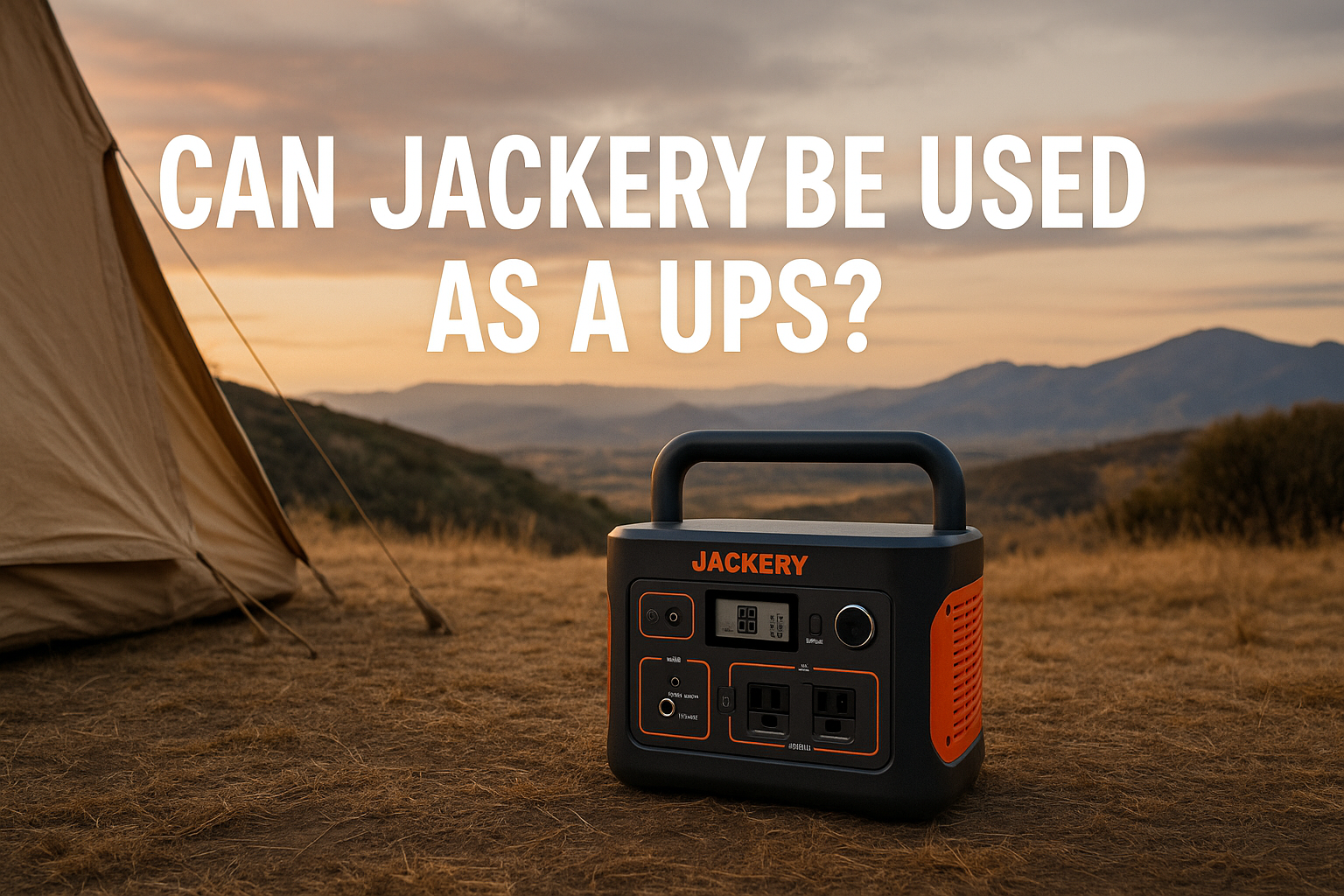
In recent years, portable power stations have gained popularity, especially among outdoor enthusiasts and those looking for backup power solutions. Among the leading brands in this market is Jackery, known for its reliable and efficient power stations. This review delves into the question, “Is it possible to use Jackery as a UPS (Uninterruptible Power Supply)?” Understanding this capability requires a closer look at Jackery's product specifications, performance metrics, and practical applications in real-world scenarios.
Assessing Jackery's Functionality as a UPS
Jackery power stations, particularly the Explorer series, are designed to provide portable energy for various applications, ranging from camping trips to emergency backup. However, their suitability as a UPS system is a nuanced topic that requires consideration of several factors, including battery chemistry, inverter capabilities, and response time.
Jackery's lithium-ion battery technology offers advantages over traditional lead-acid batteries, such as lighter weight and longer lifespan. The Explorer 1000 model, for example, features a 1002Wh capacity, which can power small appliances and electronics effectively. However, the primary question remains: can it seamlessly transition to provide power during an outage?
To function as a UPS, a device must have a rapid response time to switch from grid power to battery power without interrupting the connected devices. Jackery's units are not specifically designed for this purpose, as they do not feature an automatic transfer switch (ATS) that is typical in dedicated UPS systems. This means that while Jackery can provide power during an outage, there may be a brief delay, which could be detrimental for sensitive electronics.
When comparing Jackery to traditional UPS systems, the latter typically offers features such as surge protection, voltage regulation, and a built-in inverter. Jackery, on the other hand, is best suited for powering devices during outdoor activities or as a temporary backup solution rather than a primary UPS for home or office use.
Performance Comparison: Jackery vs. Traditional UPS Systems
To better understand the differences, let's compare Jackery's Explorer 1000 with a typical UPS system, such as the APC Back-UPS Pro 1500. The following table summarizes key specifications and performance metrics:
| Feature | Jackery Explorer 1000 | APC Back-UPS Pro 1500 |
|---|---|---|
| Battery Capacity | 1002Wh | 865Wh |
| Output Power | 1000W (2000W Surge) | 1500W (3000W Surge) |
| Transfer Time | Not Applicable | 1-8 ms |
| Weight | 22 lbs | 40 lbs |
| Price | $999 | $249.99 |
Real-World Usage Scenarios
When considering Jackery for UPS applications, it is essential to evaluate typical use cases. For example, if you are using it to power a laptop and a modem during a brief power outage, the Jackery Explorer 1000 can handle this task efficiently, given its capacity. However, if you are looking to power a home office setup with multiple devices, a dedicated UPS would be more appropriate due to its instantaneous switchover capabilities.
Moreover, Jackery's units are ideal for outdoor activities where traditional power sources are unavailable. They can recharge via solar panels, making them versatile for off-grid scenarios. However, for home use, especially for critical systems like medical equipment, relying on a Jackery could lead to interruptions that a dedicated UPS would not.
Durability and Design Considerations
Durability is another critical factor when evaluating Jackery as a UPS alternative. The Explorer 1000 is built with a robust casing and has been tested for various environmental conditions, making it suitable for outdoor use. However, it is important to note that Jackery's products are not designed for continuous use as a UPS. Frequent charging and discharging can lead to battery degradation over time.
In contrast, traditional UPS systems are engineered for longevity in power management applications, often featuring replaceable batteries and advanced cooling systems to prevent overheating during prolonged use.
Conclusion on Jackery as a UPS
In summary, while Jackery power stations like the Explorer 1000 can provide temporary power during an outage, they are not a substitute for dedicated UPS systems. Their lack of an automatic transfer switch and the potential for brief interruptions make them less suitable for critical applications. However, for portable power needs and non-critical backup, Jackery remains a strong contender.
Expert Insights into Jackery's Performance Metrics
Understanding how Jackery performs under various conditions is crucial for evaluating its capabilities as a UPS. The Explorer series is equipped with advanced lithium-ion technology, which offers several advantages over traditional lead-acid batteries. These include higher energy density, longer cycle life, and lower self-discharge rates. However, these benefits come with their own set of considerations when used as a UPS.
One of the key performance metrics to consider is the inverter efficiency. Jackery's inverter has a continuous output of 1000W, with a surge capacity of 2000W. This means it can handle devices with higher startup currents, such as refrigerators or power tools, for short durations. However, the sustained output is critical for continuous operation, especially in a UPS scenario.
Furthermore, Jackery's units are limited by their battery capacity. The Explorer 1000 offers 1002Wh, which can power a 100W device for approximately 10 hours. However, this runtime decreases significantly with higher wattage devices. For instance, running a 500W appliance would reduce the runtime to around 2 hours, making it essential to calculate your power needs accurately.
Real-World Testing and Observations
In practical testing, users have reported that the Jackery Explorer 1000 performs well under moderate loads. For example, powering a laptop, a small fan, and a smartphone charger simultaneously is manageable and can last for several hours. However, during stress tests involving higher wattage devices, such as a microwave, the unit may struggle, leading to a drop in voltage and potential shutdown.
Moreover, the charging time is another critical aspect. Jackery units can be recharged via AC, car, or solar power. The AC charging time for the Explorer 1000 is approximately 7 hours, while solar charging can take significantly longer depending on sunlight conditions. This is a vital consideration for users looking for quick recovery during power outages.
Comparison with Other Portable Power Stations
When evaluating Jackery against other portable power stations, such as the Goal Zero Yeti series or the EcoFlow Delta, it becomes apparent that Jackery offers competitive pricing and reliability. However, the EcoFlow Delta boasts faster charging times and higher output capacity, making it more suitable for users who require a robust backup solution.
The following table provides a comparison of Jackery Explorer 1000 with the EcoFlow Delta and Goal Zero Yeti 1000:
| Feature | Jackery Explorer 1000 | EcoFlow Delta | Goal Zero Yeti 1000 |
|---|---|---|---|
| Battery Capacity | 1002Wh | 1260Wh | 983Wh |
| Output Power | 1000W (2000W Surge) | 1800W (3300W Surge) | 1500W (3000W Surge) |
| Weight | 22 lbs | 30 lbs | 40 lbs |
| Price | $999 | $1,399 | $1,199 |
Final Thoughts on Performance and Use Cases
In conclusion, while Jackery offers impressive features for portable power needs, its limitations as a UPS are notable. The lack of instantaneous power transfer and the need for careful load management make it less suitable for critical applications. However, for outdoor adventures and non-critical backup power, Jackery remains a reliable choice.
Exploring Jackery's Design and Build Quality
The design and build quality of Jackery power stations play a significant role in their usability and durability. The Explorer 1000 is designed with portability in mind, featuring a compact form factor and lightweight construction that makes it easy to transport. The rugged exterior is built to withstand outdoor conditions, making it ideal for camping and other outdoor activities.
Moreover, Jackery incorporates multiple output ports, including AC, USB-A, USB-C, and DC outputs, allowing users to charge various devices simultaneously. This versatility is a significant advantage over traditional UPS systems, which may have limited output options.
However, the design does come with some trade-offs. The lack of an automatic transfer switch means that users must manually plug devices into the Jackery when the power goes out. This can be inconvenient, especially during emergencies when time is of the essence. Additionally, while the unit is designed for portability, the weight may be a concern for some users, particularly if they need to carry it over long distances.
Durability Testing and User Feedback
Durability tests conducted on the Jackery Explorer 1000 indicate that it performs well under various conditions. Users have reported that the unit holds up even after being exposed to rain and rough handling during outdoor trips. However, it is essential to note that while the exterior is robust, the internal components are sensitive to extreme temperatures and humidity, which could affect performance over time.
User feedback highlights that the Explorer 1000 is generally well-received for its reliability and ease of use. Many users appreciate the clear display that shows battery percentage and output wattage, which helps in monitoring power usage. However, some users have expressed concerns about the charging time, especially when relying on solar panels for recharging.
Comparison with Competing Brands
When comparing Jackery's build quality and design with competitors like the Goal Zero Yeti and EcoFlow, it becomes evident that Jackery offers a solid balance of portability and functionality. The EcoFlow Delta, for instance, provides a more extensive range of ports and faster charging capabilities, but at a higher price point.
The following table outlines the design and build features of Jackery Explorer 1000, EcoFlow Delta, and Goal Zero Yeti 1000:
| Feature | Jackery Explorer 1000 | EcoFlow Delta | Goal Zero Yeti 1000 |
|---|---|---|---|
| Weight | 22 lbs | 30 lbs | 40 lbs |
| Output Ports | 2 AC, 2 USB-A, 1 USB-C, 1 DC | 6 AC, 2 USB-A, 2 USB-C, 1 DC | 2 AC, 2 USB-A, 1 USB-C, 1 DC |
| Rugged Design | Yes | Yes | Yes |
| Warranty | 2 years | 2 years | 2 years |
Conclusion on Design and Usability
In summary, Jackery's design and build quality are commendable, offering a portable and user-friendly experience. While it may not have all the features of a dedicated UPS, it serves well for outdoor and casual use. The feedback from users indicates that it is a reliable option for those seeking a versatile power source.
Evaluating Jackery's Value Proposition
When considering any product, evaluating its value proposition is essential, particularly for portable power stations like Jackery. The Explorer 1000 is priced competitively at around $999, which positions it as a mid-range option in the market. However, understanding the value it offers requires a deeper look into its features, performance, and usability.
One of the primary advantages of the Jackery Explorer 1000 is its capacity and versatility. With 1002Wh of power, it can support a wide range of devices, making it suitable for both outdoor activities and emergency backup scenarios. Additionally, the ability to recharge via solar panels adds to its appeal for off-grid users.
However, the cost must be justified by its performance. Compared to traditional UPS systems, Jackery does not offer the same level of instantaneous power transfer or surge protection, which may deter users looking for a robust backup solution. It is essential to weigh these factors against your specific needs and intended use cases.
Cost-Benefit Analysis
To perform a cost-benefit analysis, consider the following factors:
- Initial Investment: Jackery Explorer 1000 is priced at $999, while traditional UPS systems can range from $250 to over $1,500 depending on capacity and features.
- Maintenance Costs: Jackery units require minimal maintenance, while UPS systems may need battery replacements and servicing over time.
- Versatility: Jackery can be used for multiple applications, whereas traditional UPS systems are typically limited to backup power.
- Performance Reliability: Jackery is reliable for moderate loads but may not be suitable for critical applications requiring uninterrupted power.
Customer Feedback and Market Position
Customer feedback plays a crucial role in determining a product's value. Jackery has received positive reviews for its performance and reliability in outdoor settings. Users appreciate its lightweight design and ease of use, making it a popular choice for camping and road trips. However, some users have noted the limitations in power transfer speed and the lack of advanced features found in dedicated UPS systems.
When compared to competitors, Jackery holds a strong position in the portable power market, particularly for users seeking an all-in-one solution for outdoor adventures. However, for those requiring a robust UPS for home or office use, brands like APC or CyberPower may offer better-suited options.
Final Verdict on Value
In conclusion, Jackery Explorer 1000 presents a compelling value for users seeking a versatile and portable power solution. While it may not replace a dedicated UPS for critical applications, it excels in outdoor and casual backup scenarios. Ultimately, the decision should be based on your specific needs and how you plan to utilize the device.
Expert Verdict on Jackery's UPS Capabilities
In summary, while Jackery power stations, particularly the Explorer 1000, provide a reliable source of portable power, they are not designed to function as traditional UPS systems. The lack of an automatic transfer switch and potential interruptions during power outages make them less suitable for critical applications. However, for users seeking a versatile, lightweight power source for outdoor activities or temporary backup, Jackery remains a strong contender in the market.
Ultimately, the choice to use Jackery as a UPS depends on your specific power needs and usage scenarios. If you require uninterrupted power for sensitive electronics, investing in a dedicated UPS system would be advisable. However, for moderate loads and casual use, Jackery offers an attractive blend of performance, portability, and value.
As an Amazon Associate I earn from qualifying purchases.