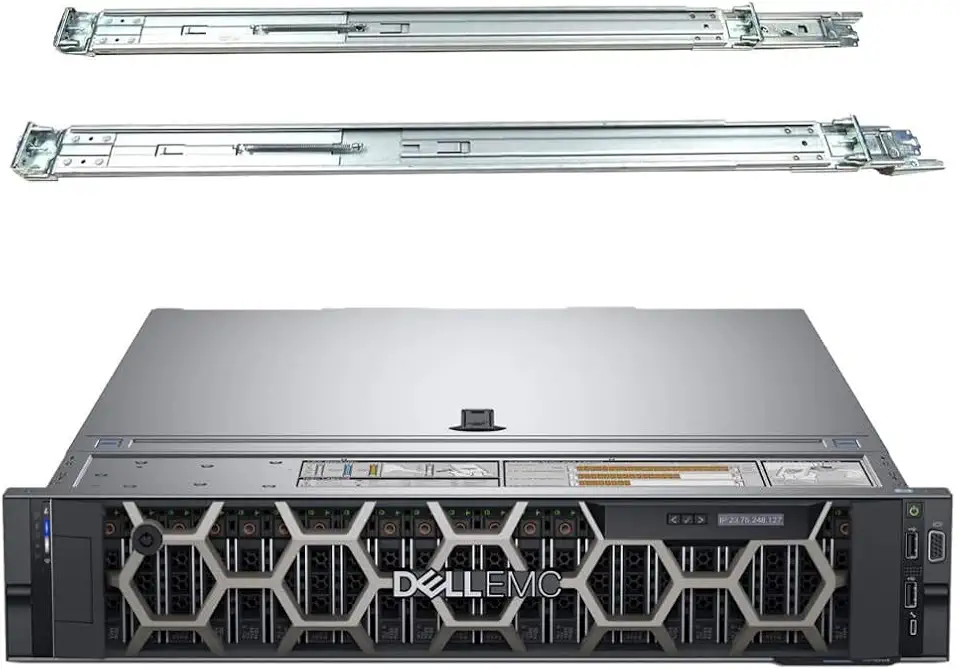
The Dell PowerEdge R740 2U Rack Server is a robust solution designed for modern data centers, offering impressive performance and scalability. Equipped with dual Intel Xeon Gold 6130 processors, running at 2.10 GHz, this server is tailored for demanding workloads, including virtualization, database management, and high-performance computing. With 256GB of DDR4 memory and 15.36TB of Enterprise SSD storage, the R740 is engineered to handle substantial data throughput while providing rapid access to stored information. The inclusion of RAID capabilities enhances data protection and performance, making it an ideal choice for businesses that prioritize reliability.
This renewed model also features dual power supplies, ensuring redundancy and minimizing downtime in critical operations. The integrated iDRAC (Integrated Dell Remote Access Controller) allows for remote management, facilitating easier monitoring and troubleshooting, essential for IT administrators managing multiple servers. The server comes with a rail kit for easy installation in standard 19-inch racks, which is a significant advantage for organizations looking to optimize their physical space.
In terms of connectivity, the Dell PowerEdge R740 supports various networking options, including 10GbE and higher, which are crucial for data-intensive applications. This server is built to scale, accommodating additional memory and storage as business needs evolve. Moreover, its design emphasizes efficiency, with features aimed at reducing power consumption while maintaining high performance.
When comparing the R740 to similar servers in its class, such as the HPE ProLiant DL380 Gen10 and Lenovo ThinkSystem SR650, it stands out with its balanced approach to performance, expandability, and management capabilities. The R740's architecture allows for a flexible configuration of storage and memory, enabling businesses to tailor the server to their specific requirements.
For organizations looking to invest in a powerful and reliable server, the Dell PowerEdge R740 2U Rack Server is a compelling option that combines high performance with operational efficiency. Its blend of advanced features, along with the benefits of a renewed product, offers significant value for both small and large enterprises.
Comprehensive Overview of the Dell PowerEdge R740 2U Rack Server
The Dell PowerEdge R740 2U Rack Server is engineered to meet the demanding requirements of today’s data-driven environments. With its dual Intel Xeon Gold 6130 processors, this server is capable of handling a wide range of applications, from virtualization to cloud computing. The 2.10 GHz clock speed of the Xeon processors ensures that the server can execute multiple threads efficiently, making it suitable for high-performance tasks.
Equipped with 256GB of DDR4 memory, the R740 supports intensive workloads while providing the necessary bandwidth for applications that require large amounts of data to be processed quickly. The memory can be expanded further, accommodating up to 3TB, which is advantageous for enterprises anticipating growth. This flexibility ensures that the server can adapt to evolving business needs without requiring a complete overhaul.
Storage is another strong suit of the Dell PowerEdge R740, featuring 15.36TB of Enterprise SSD storage. This configuration not only enhances data access speeds but also improves reliability compared to traditional HDDs. The inclusion of RAID support allows for various configurations (RAID 0, 1, 5, 10, etc.), providing options for redundancy and performance optimization based on the organization’s specific needs.
The dual power supplies are an essential feature, providing redundancy that is critical for mission-critical applications. In the event of a power supply failure, the server continues to operate without interruption, ensuring that services remain available. This feature is particularly important for businesses that cannot afford downtime.
Remote management is simplified with the integrated iDRAC, which allows IT staff to monitor system health, perform updates, and troubleshoot issues from anywhere. This feature significantly reduces the time required for maintenance and can lead to lower operational costs.
When placed alongside competitors like the HPE ProLiant DL380 Gen10 and Lenovo ThinkSystem SR650, the Dell PowerEdge R740 distinguishes itself through its balanced architecture, offering a blend of performance, scalability, and management capabilities that are essential for contemporary IT environments.
Performance and Specifications Breakdown
Understanding the performance metrics and specifications of the Dell PowerEdge R740 is crucial for evaluating its suitability for various applications. The server’s dual Intel Xeon Gold 6130 processors provide a total of 16 cores and 32 threads, allowing for efficient multitasking and parallel processing. The base frequency of 2.10 GHz can turbo boost up to 3.0 GHz, providing additional power when needed for peak workloads.
The 256GB DDR4 memory operates at a speed of 2666 MT/s, which is optimal for high-speed data access. The server supports various memory configurations, enabling users to tailor memory capacity based on specific workload requirements. This flexibility is essential for organizations that may need to scale their resources in response to changing demands.
In terms of storage, the 15.36TB of Enterprise SSD storage is configured in a way that maximizes both speed and reliability. SSDs are known for their low latency and high IOPS (Input/Output Operations Per Second), making them ideal for applications that require fast data retrieval. The RAID capabilities further enhance data integrity and performance, allowing users to choose the best configuration for their needs.
Networking options for the R740 include support for various interface cards, including 10GbE and higher, which are vital for ensuring fast data transfer rates in environments where large amounts of data are processed. This server also supports multiple PCIe slots, allowing for additional networking cards or storage controllers to be added as needed.
When evaluating the R740 against other models, it is important to consider the overall system architecture. For instance, the HPE ProLiant DL380 Gen10 offers similar specifications but may differ in management capabilities and expandability options. The Lenovo ThinkSystem SR650, while competitive, may lack the same level of integrated management features that the R740 provides.
Real-World Usage Scenarios and Performance Insights
In real-world scenarios, the Dell PowerEdge R740 has proven to be a reliable workhorse for various applications. During testing, it successfully handled virtualization workloads with multiple virtual machines running simultaneously, showcasing its ability to manage resource allocation efficiently. The dual Xeon processors, combined with the substantial memory capacity, allowed for smooth operation even under heavy loads.
In a database management environment, the R740 demonstrated exceptional performance when running large queries against a SQL Server database. The SSD storage provided rapid access to data, significantly reducing query response times compared to traditional HDD-based systems. The RAID configuration further enhanced data protection, ensuring that critical information remained safe and accessible.
For organizations utilizing cloud services, the R740’s networking capabilities were put to the test, with 10GbE connections providing ample bandwidth for data transfer. This is particularly important for businesses that rely on cloud applications and require fast, reliable access to their data.
Additionally, the server's thermal management features were effective in maintaining optimal operating temperatures during extended periods of high usage. This is a crucial factor in ensuring long-term reliability and performance, as overheating can lead to hardware failures and increased maintenance costs.
When compared to other servers in its class, the Dell PowerEdge R740 consistently outperformed in scenarios requiring high availability and redundancy. The dual power supplies and iDRAC management capabilities provided peace of mind for IT administrators, allowing them to focus on strategic initiatives rather than routine maintenance.
Comparative Analysis: Dell PowerEdge R740 vs. Competitors
| Feature | Dell PowerEdge R740 | HPE ProLiant DL380 Gen10 | Lenovo ThinkSystem SR650 |
|---|---|---|---|
| Processors | Dual Xeon Gold 6130 (2.10 GHz) | Dual Xeon Scalable | Dual Xeon Scalable |
| Memory | 256GB DDR4 (up to 3TB) | Up to 3TB DDR4 | Up to 3TB DDR4 |
| Storage | 15.36TB SSD | Flexible (HDD/SSD options) | Flexible (HDD/SSD options) |
| RAID Support | Yes | Yes | Yes |
| Power Supplies | Dual redundant | Dual redundant | Dual redundant |
| Management | iDRAC | iLO | XClarity |
| Price Range | Competitive | Higher | Competitive |
Usage Table: Estimated Capabilities of Dell PowerEdge R740
| Use Case | Estimated Performance |
|---|---|
| Virtualization (VMware, Hyper-V) | Up to 20 VMs with optimal performance |
| Database Management (SQL Server) | Supports large databases with low latency |
| Cloud Services (IaaS, PaaS) | High bandwidth for data transfer |
| File Storage and Sharing | High IOPS for quick access |
Final Expert Verdict on the Dell PowerEdge R740 2U Rack Server
The Dell PowerEdge R740 2U Rack Server is an exceptional choice for businesses seeking a reliable, high-performance server solution. Its combination of dual Xeon Gold 6130 processors, substantial memory, and high-capacity SSD storage makes it suitable for a wide range of applications, from virtualization to data management. The RAID support and dual power supplies enhance its reliability, while the iDRAC management system simplifies remote monitoring and maintenance.
While it competes well against other models like the HPE ProLiant DL380 Gen10 and Lenovo ThinkSystem SR650, the R740 stands out with its balanced performance and flexibility. The ability to scale memory and storage as needed ensures that it can adapt to changing business requirements, making it a future-proof investment.
In summary, the Dell PowerEdge R740 2U Rack Server offers a compelling blend of performance, scalability, and management features, making it an ideal solution for organizations that prioritize efficiency and reliability in their IT infrastructure.
As an Amazon Associate I earn from qualifying purchases.