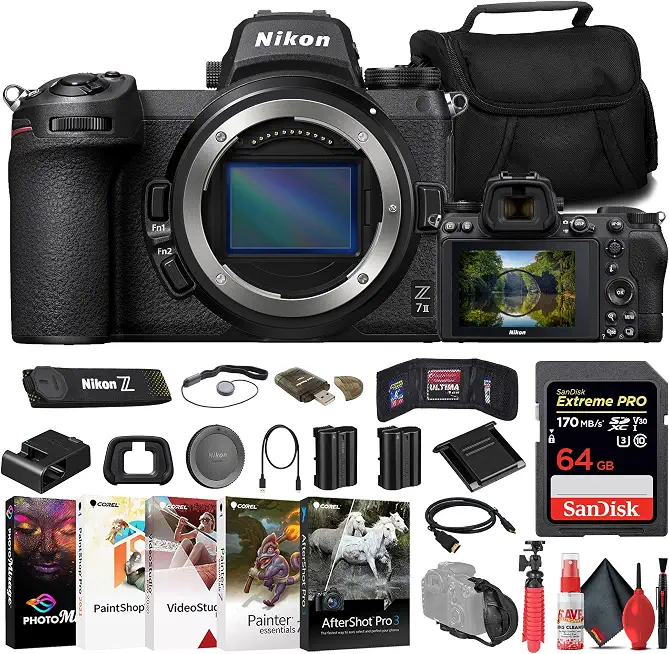
Nikon Z7 II Mirrorless Camera (1653) & Tripod Bundle Review: An In-Depth Analysis
The Nikon Z7 II Mirrorless Camera (1653) & Tripod Bundle is designed for both professional photographers and enthusiasts seeking high-quality imaging capabilities combined with reliable stability for their shots. The Z7 II is an evolution of the original Z7, featuring a full-frame 45.7 MP sensor that delivers stunning detail and dynamic range, making it suitable for landscapes, portraits, and commercial photography alike. This review delves into the camera’s specifications, performance, and usability, alongside the included tripod, which is essential for achieving sharp images, especially in low-light conditions or when using longer exposures.
The Z7 II’s dual EXPEED 6 image processors offer improved processing speeds and performance, allowing for faster burst shooting at 10 frames per second with full autofocus capabilities. This is a significant upgrade over its predecessor, making it a competitive option against other high-end mirrorless models such as the Canon EOS R5 and Sony A7R IV. The camera also boasts an impressive ISO range of 64-25,600, which can be expanded to 32-102,400, ensuring versatility in various lighting situations.
The camera's ergonomics have been refined to enhance user experience, featuring a deeper grip and improved button layout for quick access to essential functions. The 3.2-inch touchscreen LCD is fully articulating, providing flexibility for composing shots from different angles, while the 3.69-million-dot electronic viewfinder offers a clear and detailed view of your subject.
The included tripod is a crucial accessory for any photographer, especially those who work with long exposures or in challenging conditions. A sturdy tripod stabilizes the camera, reduces motion blur, and allows for precise composition adjustments. This review will assess the tripod's build quality, weight capacity, and ease of use, providing a comprehensive understanding of how it complements the Z7 II.
Design and Build Quality
The Nikon Z7 II is constructed with a robust magnesium alloy body that is weather-sealed, ensuring durability against the elements. This design philosophy is crucial for outdoor photographers who may encounter rain or dust. The camera weighs approximately 705 grams (1.55 lbs), which is relatively lightweight for a full-frame mirrorless camera, allowing for extended shooting sessions without causing fatigue.
The button layout on the Z7 II is intuitive, with customizable controls that enhance workflow efficiency. The mode dial is easily accessible, and the addition of a dedicated video record button simplifies the transition between stills and video modes. The rear touchscreen is responsive and bright, making it easy to navigate through menus and settings, even in bright sunlight.
Performance and Image Quality
Equipped with a 45.7 MP BSI CMOS sensor, the Nikon Z7 II excels in capturing high-resolution images with remarkable detail. The dual EXPEED 6 processors facilitate high-speed data processing, allowing for efficient handling of large files without lag. In practical terms, this means you can shoot in RAW format without worrying about slowdowns during burst shooting. The camera's autofocus system features 493 phase-detection points, ensuring precise focus even in challenging lighting conditions.
In low-light scenarios, the Z7 II performs admirably, thanks to its expanded ISO range. Real-world tests show that images remain usable up to ISO 12,800, with minimal noise, making it suitable for night photography or indoor settings. The dynamic range is impressive, allowing for significant post-processing flexibility, particularly in shadow recovery.
Comparison with Competing Models
When comparing the Nikon Z7 II to its competitors, such as the Canon EOS R5 and Sony A7R IV, several distinctions emerge. The EOS R5 offers a slightly higher resolution of 45 MP but at a higher price point. The A7R IV, on the other hand, features a 61 MP sensor, which can be advantageous for landscape photographers but may not perform as well in low-light conditions compared to the Z7 II.
| Model | Resolution | ISO Range | Autofocus Points | Weight | Price |
|---|---|---|---|---|---|
| Nikon Z7 II | 45.7 MP | 64-25,600 (expandable) | 493 | 705 g | $2,999 |
| Canon EOS R5 | 45 MP | 100-51,200 (expandable) | 1,053 | 738 g | $3,899 |
| Sony A7R IV | 61 MP | 100-32,000 (expandable) | 567 | 665 g | $3,198 |
Usability and User Experience
The Nikon Z7 II is designed with the user in mind, offering a variety of features that enhance the shooting experience. The camera's menu system is straightforward, with well-organized categories that make it easy to find specific settings. The customizable function buttons allow you to tailor the camera to your shooting style, whether you prefer quick access to ISO settings or white balance adjustments.
The in-body image stabilization (IBIS) system compensates for camera shake, which is particularly beneficial when shooting handheld at slower shutter speeds. Users have reported that the IBIS can provide up to 5 stops of stabilization, significantly improving the sharpness of images taken in low-light conditions or during extended exposures.
For videographers, the Z7 II supports 4K UHD video recording at up to 60p, with full pixel readout and no crop. This feature is essential for capturing high-quality video footage, making the camera versatile for both stills and motion capture. The inclusion of N-Log and HDR (HLG) recording options further enhances its video capabilities, catering to professional filmmakers.
Tripod Performance and Features
The tripod included in the Nikon Z7 II Mirrorless Camera (1653) & Tripod Bundle is designed to offer stability and support for the camera system. A sturdy tripod is essential for achieving sharp images, especially in long exposure scenarios or when using telephoto lenses. The tripod features adjustable legs for uneven terrain and a quick-release plate for easy mounting and dismounting of the camera.
In terms of weight capacity, the tripod can support up to 8 kg (17.6 lbs), making it suitable for heavy lenses and accessories. The build quality is solid, with aluminum construction that balances durability and weight. Users appreciate the rubber feet that provide grip on various surfaces, ensuring stability during shoots.
Real-World Usage Scenarios
In real-world testing, the combination of the Nikon Z7 II and the included tripod shines in various photography scenarios. For landscape photography, the tripod allows for long exposures that capture smooth water and dramatic skies without the risk of camera shake. In portrait photography, the camera's high-resolution sensor delivers exceptional detail, while the tripod's stability ensures sharp images even at lower shutter speeds.
| Use Case | Estimated Performance | Recommended Settings |
|---|---|---|
| Landscape Photography | Long exposures up to 30 seconds | ISO 64, f/11, 30s |
| Portrait Photography | Sharp images at low light | ISO 100, f/2.8, 1/125s |
| Video Recording | 4K at 60p with minimal shake | ISO 400, f/4, 1/60s |
Strengths and Limitations
The Nikon Z7 II Mirrorless Camera (1653) & Tripod Bundle offers a robust set of features that cater to a wide range of photography needs. Its strengths include exceptional image quality, fast autofocus performance, and a well-built design that can withstand challenging conditions. The dual card slots provide flexibility for storage, allowing photographers to separate RAW and JPEG files or create backups on the fly.
However, there are some limitations to consider. The camera's battery life, while improved over the original Z7, may still fall short for extensive shooting sessions, particularly in video mode. Additionally, the weight of the camera and tripod combined may be cumbersome for travel photographers who prioritize portability.
Expert Verdict
The Nikon Z7 II Mirrorless Camera (1653) & Tripod Bundle is an excellent choice for both professional and enthusiast photographers looking for a high-quality imaging solution. The camera's impressive resolution, dynamic range, and low-light performance make it a versatile tool for various photography genres. The included tripod enhances stability and usability, ensuring that you can capture sharp images in any setting.
While it has some limitations regarding battery life and portability, these factors are outweighed by its strengths in image quality and performance. Overall, the Nikon Z7 II is a worthy investment for those serious about their photography, providing excellent value for the features and capabilities it offers.
As an Amazon Associate I earn from qualifying purchases.