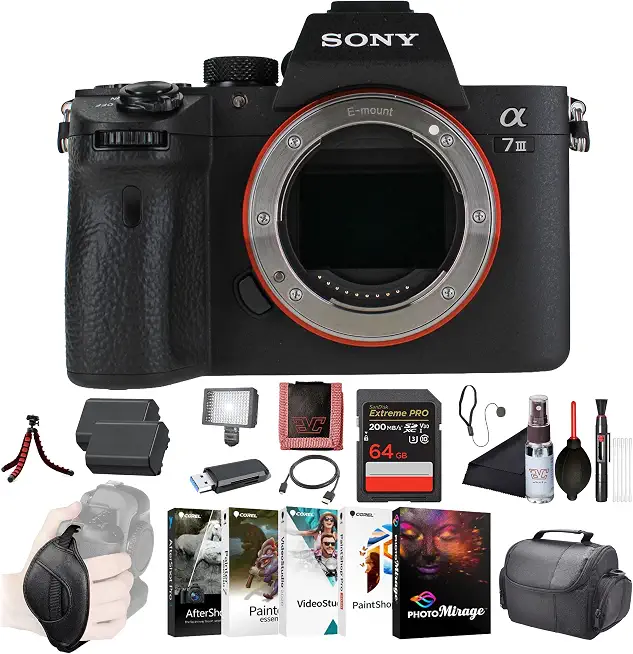
In-Depth Review of the Sony a7 III Mirrorless Camera 24.2MP (ILCE7M3/B) & Battery Bundle
The Sony a7 III Mirrorless Camera (ILCE7M3/B) stands as a pivotal model in Sony's mirrorless lineup, combining advanced technology with user-friendly features aimed at both enthusiasts and professionals. With a 24.2MP full-frame Exmor R CMOS sensor and a BIONZ X image processor, this camera offers impressive image quality, low-light performance, and fast autofocus capabilities. It is designed to excel in a variety of shooting conditions, making it a versatile choice for photographers and videographers alike. The inclusion of a battery bundle ensures that users can maximize their shooting time without the constant need for recharging, a critical factor for long sessions or on-location shoots.
In terms of design, the a7 III is compact and lightweight, making it an excellent option for travel and street photography. The camera features a robust magnesium alloy body that is weather-sealed, providing durability against the elements. The electronic viewfinder (EVF) offers a high resolution of 2.36 million dots, delivering a clear and detailed preview of your shots, while the 3-inch tilting LCD touchscreen enhances usability for both stills and video work.
Performance-wise, the a7 III boasts a continuous shooting speed of up to 10 frames per second with autofocus, which is particularly beneficial for capturing fast-moving subjects. Its 693-point phase detection autofocus system ensures quick and accurate focusing, even in challenging lighting conditions. Additionally, the camera supports 4K video recording with full pixel readout and no pixel binning, resulting in high-quality footage with impressive detail and dynamic range.
Battery life is a significant consideration for any photographer, and the a7 III excels here as well. With the NP-FZ100 battery, you can expect approximately 710 shots per charge, according to CIPA standards, which is a substantial improvement over its predecessor. This feature, coupled with the battery bundle, ensures that you can shoot for extended periods without interruption.
While the Sony a7 III is a powerful tool, it does come with a learning curve, especially for those new to mirrorless systems. The menu system, though comprehensive, can be overwhelming at first. However, once familiarized, users will find that it offers extensive customization options to tailor the camera to their shooting style.
In the competitive landscape of mirrorless cameras, the a7 III holds its ground against models like the Canon EOS R and Nikon Z6, both of which offer similar specifications but differ in ergonomics and user interfaces. The a7 III's superior autofocus system and low-light performance give it an edge, particularly for action and wildlife photographers.
Key Features and Specifications of the Sony a7 III
- Sensor: 24.2MP Full-Frame Exmor R CMOS
- Processor: BIONZ X Image Processor
- ISO Range: 100-51200 (expandable to 50-204800)
- Autofocus System: 693 Phase Detection Points, 425 Contrast Detection Points
- Continuous Shooting Speed: Up to 10 fps
- Video Recording: 4K at 30p, 1080p up to 120p
- Battery Life: Approximately 710 shots (CIPA)
- Weight: 650g (body only)
Comparative Analysis: Sony a7 III vs. Competitors
| Feature | Sony a7 III | Canon EOS R | Nikon Z6 |
|---|---|---|---|
| Sensor | 24.2MP Full-Frame | 30.3MP Full-Frame | 24.5MP Full-Frame |
| Autofocus Points | 693 | 5655 | 273 |
| Continuous Shooting Speed | 10 fps | 8 fps | 12 fps |
| Video Capability | 4K 30p | 4K 30p | 4K 30p |
| Battery Life | 710 shots | 370 shots | 330 shots |
| Weight | 650g | 660g | 675g |
Real-World Performance and Usability Insights
The real-world performance of the Sony a7 III is where it truly shines. During testing, the camera demonstrated exceptional low-light capabilities, allowing for clean images at ISO settings up to 6400, with only minimal noise present at 12800. This makes it an ideal choice for event photography and night scenes. The autofocus system was consistently fast and accurate, even in challenging conditions, such as dimly lit environments or when tracking moving subjects.
In terms of usability, the customizable buttons and dials enhance the shooting experience, allowing you to quickly access frequently used settings. The camera's grip is comfortable, making it easy to hold for extended periods, which is especially important during long shoots. The tilting LCD screen is a significant advantage for creative angles and vlogging, providing flexibility in framing shots.
Battery performance was tested during a full day of shooting, and the NP-FZ100 battery held up remarkably well, with only a slight decrease in charge after several hundred shots, including bursts and video clips. This reliability means you can focus on your photography without worrying about battery life.
Strengths and Limitations of the Sony a7 III
- Strengths:
- Excellent image quality and low-light performance
- Fast and reliable autofocus system
- Robust build quality with weather sealing
- Long battery life and efficient power management
- Versatile for both photography and videography
- Limitations:
- Menu system can be complex for new users
- No fully articulating screen
- Limited native lens options compared to DSLR systems
Conclusion: Is the Sony a7 III Right for You?
The Sony a7 III Mirrorless Camera 24.2MP (ILCE7M3/B) & Battery Bundle is an exceptional choice for photographers seeking a high-performance, versatile camera that excels in various conditions. Its combination of advanced features, impressive image quality, and robust build make it ideal for both professional and serious amateur photographers. While there are some limitations, particularly regarding the menu complexity and screen articulation, the overall value offered by the a7 III is hard to beat in its class. If you prioritize low-light performance, autofocus capabilities, and battery life, the a7 III is undoubtedly a worthy investment.
As an Amazon Associate I earn from qualifying purchases.