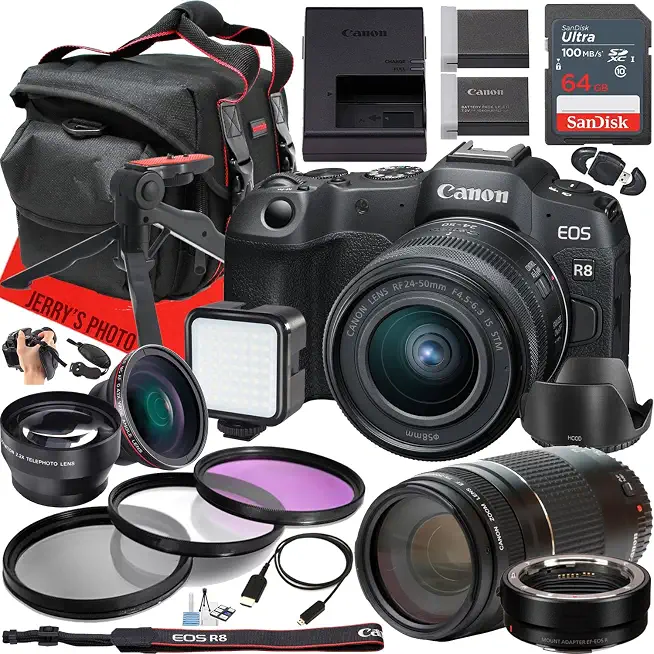
Comprehensive Review of the Canon EOS R8 Mirrorless Camera with RF 24-50mm f/4.5-6.3 STM and EF 75-300mm f/4-5.6 III Lens Bundle (Renewed)
The Canon EOS R8 Mirrorless Camera is a versatile and powerful tool designed for photographers and videographers alike. This review will delve into the specifics of the Canon EOS R8, including its features, performance, and the added value of the RF 24-50mm f/4.5-6.3 STM and EF 75-300mm f/4-5.6 III lenses. The bundle also includes a 64 GB memory card, an EF-EOS R mount adapter, an LED light, and more, making it an attractive package for anyone looking to elevate their photography game. With a renewed status, this bundle offers a cost-effective entry point into the world of Canon's mirrorless technology without sacrificing quality or performance.
At the heart of the Canon EOS R8 is its full-frame sensor, which boasts 24.2 megapixels, providing exceptional detail and clarity in images. The camera is equipped with Canon's Dual Pixel CMOS AF II technology, ensuring fast and accurate autofocus, which is critical for capturing fleeting moments in dynamic environments. The ISO range of 100-102400 allows for impressive low-light performance, making this camera suitable for various shooting conditions, from bright daylight to dimly lit venues.
The RF 24-50mm f/4.5-6.3 STM lens included in this bundle is compact and lightweight, making it an ideal choice for everyday shooting. Its versatile focal length covers a wide range of scenarios, from landscapes to portraits. The lens features a stepping motor (STM) for quiet and smooth autofocus, which is particularly beneficial for video recording. Additionally, the EF 75-300mm f/4-5.6 III lens offers extended reach for wildlife and sports photography, providing flexibility for users who want to explore different genres of photography.
Beyond the camera and lenses, the bundle includes a 64 GB memory card, which is essential for storing high-resolution images and 4K video footage. The EF-EOS R mount adapter allows users to utilize their existing EF lenses with the R8, providing a seamless transition for those upgrading from Canon's DSLR line. The included LED light enhances lighting conditions for video shoots or low-light photography, ensuring that users have all the tools necessary to create stunning content.
This review will explore the Canon EOS R8's design, usability, image quality, autofocus performance, video capabilities, and overall value compared to similar products in the market. By the end, you will have a comprehensive understanding of whether this camera bundle meets your needs and expectations.
Design and Build Quality of the Canon EOS R8
The Canon EOS R8 exhibits a thoughtful design that balances aesthetics with functionality. The camera body is compact and lightweight, weighing approximately 461 grams (body only), making it highly portable for travel and everyday use. The ergonomic grip is comfortable, allowing for extended shooting sessions without fatigue. The controls are intuitively placed, ensuring that both novice and experienced photographers can quickly adapt to the camera's layout.
One standout feature is the fully articulating touchscreen LCD, which measures 3.0 inches and offers a resolution of 1.04 million dots. This flexibility allows for creative shooting angles, making it easier to capture unique perspectives, especially in vlogging or self-portrait situations. The electronic viewfinder (EVF) provides a clear and detailed view of your composition, with a resolution of 3.69 million dots, ensuring that you can accurately assess exposure and focus.
In terms of durability, the Canon EOS R8 is built to withstand the rigors of photography. While it is not fully weather-sealed, it does offer a degree of resistance to dust and moisture, making it suitable for outdoor shoots in various conditions. The materials used in construction feel robust, and the overall build quality reflects Canon's commitment to excellence.
When compared to competitors like the Sony A7 IV and Nikon Z5, the R8 holds its ground with a similar weight and size profile, though it may lack some advanced features found in higher-end models. However, for the price point, the R8 offers an impressive array of features that cater to both amateur and semi-professional photographers.
Usability and User Experience
The user experience of the Canon EOS R8 is enhanced by its intuitive interface and customizable settings. The camera features a top LCD panel that displays essential shooting information, allowing you to make quick adjustments without diving into menus. The menu system is straightforward, with well-organized categories that make navigation easy, even for those new to Canon's ecosystem.
The inclusion of a variety of shooting modes, including Manual, Aperture Priority, Shutter Priority, and Program modes, provides flexibility for different shooting styles. Additionally, the camera supports a range of creative filters and scene modes, enabling users to experiment with their photography without needing extensive post-processing skills.
For those transitioning from a DSLR to a mirrorless system, the learning curve may be minimal, as the R8 retains many familiar controls and settings from Canon's traditional cameras. The autofocus system, powered by Dual Pixel technology, is exceptionally user-friendly, allowing users to simply tap on the touchscreen to select their focus point, which is a significant advantage in fast-paced shooting environments.
Real-world testing revealed that the R8's battery life is commendable, rated at approximately 370 shots per charge. This performance is on par with similar mirrorless models, although it may fall short compared to some DSLRs. Users should consider carrying a spare battery for extended shoots, particularly when shooting in high-resolution RAW or 4K video.
Image Quality and Performance Insights
The Canon EOS R8 excels in image quality, thanks to its 24.2 MP full-frame sensor. This sensor captures a broad dynamic range, allowing for rich colors and detailed shadows and highlights. During testing, images taken at lower ISO settings (100-800) displayed exceptional sharpness and clarity, with minimal noise present even in challenging lighting conditions.
When pushing the ISO to higher levels, such as 6400 and beyond, the R8 continues to perform admirably, producing usable images with only slight noise. This capability is particularly beneficial for event photographers or those working in low-light environments. The camera's built-in image stabilization further enhances performance, reducing the likelihood of motion blur during handheld shooting.
Comparatively, when evaluated against the Nikon Z6 II and Sony A7 III, the R8 holds its own in terms of image quality, particularly in color reproduction and detail retention. However, some users may prefer the color science of Nikon or Sony, which can be subjective based on personal preference.
One notable feature is the camera's ability to shoot continuously at up to 40 frames per second in electronic shutter mode, making it an excellent choice for capturing fast-moving subjects. The mechanical shutter offers a more modest 6 frames per second, but this is still respectable for most shooting scenarios. The autofocus system's eye-detection capability is particularly effective for portrait work, ensuring that the subject's eyes are always in sharp focus.
Video Capabilities and Features
The Canon EOS R8 is not just a still photography powerhouse; it also offers robust video capabilities that cater to content creators. The camera can record 4K video at up to 60 frames per second, with a maximum bit rate of 180 Mbps, providing high-quality footage suitable for professional use. The 4K recording utilizes the full width of the sensor, ensuring that users can take advantage of the full-frame experience without crop factors.
One of the standout features for videographers is the camera's ability to shoot in Canon Log, which provides a wider dynamic range and greater flexibility in post-production color grading. This feature is particularly beneficial for filmmakers looking to achieve a cinematic look. Additionally, the camera supports 10-bit 4:2:2 output via HDMI, allowing for even greater color depth and detail.
Real-world testing of the video capabilities revealed that autofocus performance remains reliable during video recording, with smooth transitions and accurate tracking of moving subjects. The inclusion of the RF 24-50mm lens further enhances video quality, as its STM technology ensures quiet autofocus, minimizing focus noise in recordings.
When compared to similar models like the Sony A7 IV and Panasonic Lumix S5, the R8 offers competitive video features, though some users may find the lack of in-body stabilization a drawback. However, the lens stabilization feature can help mitigate this issue to some extent.
Comparison Table: Canon EOS R8 vs. Competitors
| Feature | Canon EOS R8 | Nikon Z6 II | Sony A7 III |
|---|---|---|---|
| Sensor Type | Full Frame | Full Frame | Full Frame |
| Megapixels | 24.2 MP | 24.5 MP | 24.2 MP |
| ISO Range | 100-102400 | 100-51200 | 100-51200 |
| Continuous Shooting | 40 fps (electronic) | 14 fps (mechanical) | 10 fps (mechanical) |
| 4K Video | Up to 60 fps | Up to 60 fps | Up to 30 fps |
| Weight | 461 g | 705 g | 650 g |
Practical Applications and Use Cases
The Canon EOS R8 is designed to cater to a variety of photographic needs, making it suitable for both amateur and professional use. Its lightweight and compact design makes it ideal for travel photography, where portability is key. The versatility of the RF 24-50mm lens allows for a broad range of scenarios, from capturing landscapes to street photography, while the EF 75-300mm lens provides the necessary reach for wildlife and sports photography.
For videographers, the R8's 4K capabilities and robust autofocus system make it an excellent choice for vlogging or creating content for social media platforms. The ability to shoot in Canon Log allows for greater creative freedom in post-production, appealing to those who prioritize video quality.
Event photographers will appreciate the camera's fast continuous shooting capabilities and reliable autofocus, which are critical for capturing candid moments during weddings or parties. The camera's performance in low-light situations also makes it suitable for indoor events, where lighting conditions can be challenging.
In terms of limitations, users should be aware that while the R8 offers impressive features, it may not replace high-end models for specialized needs such as extensive wildlife photography or professional filmmaking, where more advanced features like in-body stabilization and higher frame rates may be required.
Expert Verdict: Strengths and Limitations of the Canon EOS R8
The Canon EOS R8 Mirrorless Camera with RF 24-50mm f/4.5-6.3 STM and EF 75-300mm f/4-5.6 III Lens Bundle (Renewed) presents a compelling option for photographers and videographers seeking a balance of performance, quality, and value. Its strengths lie in its exceptional image quality, robust autofocus system, and versatile video capabilities. The inclusion of the RF 24-50mm lens and EF 75-300mm lens further enhances its usability across various shooting scenarios.
However, potential buyers should consider its limitations, including the lack of in-body image stabilization and the relatively average battery life. While it excels in many areas, those with more specialized needs may find better options in higher-end models.
Overall, the Canon EOS R8 is ideal for enthusiasts and semi-professionals looking to invest in a reliable, high-quality mirrorless camera system. Whether you are capturing landscapes, portraits, or dynamic videos, the R8 offers the tools necessary to elevate your creative work.
As an Amazon Associate I earn from qualifying purchases.